
Islamic Civilisation in Southern Africa and the Indian Ocean Islands
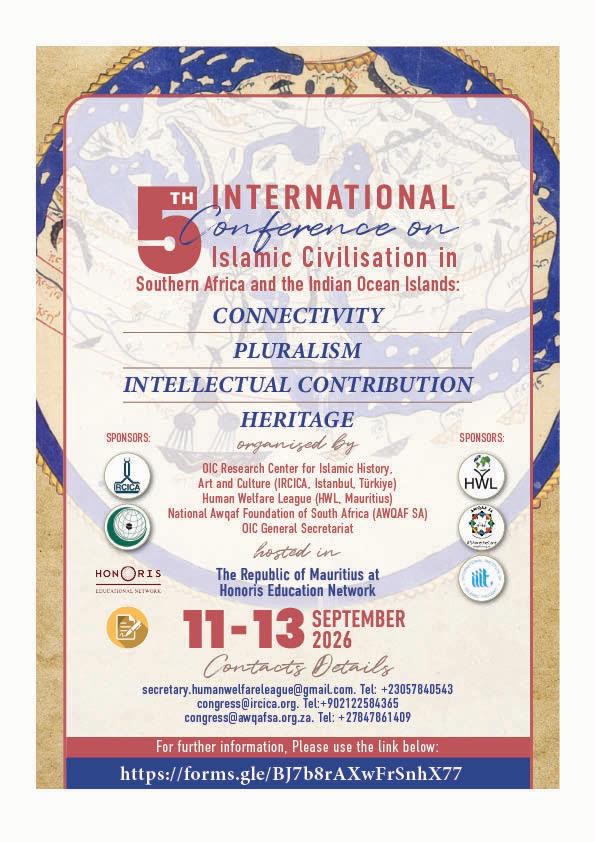
have for centuries been active participants in African and Indian Ocean networks of trade, scholarship, and cultural exchange. Their distinctive intellectual traditions, architectural heritage, and models of minority citizenship remain largely undocumented and undervalued in global scholarship.
This conference recovers this hidden history and asserts the region’s significance as a centre of Islamic civilisation. It will provide a platform for scholars, heritage practitioners, and community custodians to collectively examine the region’s connectivity, scholarly contributions, and living heritage.
By centering Southern Africa and the Indian Ocean islands, this conference will decolonise Islamic studies, foster regional research collaboration, and ensure that this rich civilisational legacy is recognised, safeguarded, and transmitted to future generations.
Objectives
- To re-centre Islamic civilisational studies within Southern Africa and Indian Ocean.
- To highlight intellectual, cultural and social contributions of Muslims and Islamic institutions in Southern Africa and the Indian Ocean.
- To strengthen regional and international research networks and brotherhood.
- To promote better understanding and dialogue with people of other faiths and cultural communities.
- To explore how Islamic heritage in the region continues to evolve in contemporary contexts.
Conference Themes and Sub-themes
The conference offers a rich opportunity to explore the historical depth and contemporary expressions of Islamic civilisation in Southern Africa and the Indian Ocean Islands. It welcomes interdisciplinary contributions from history, religious studies, anthropology, sociology, law, political science, heritage studies, literature, architecture, economics, and related fields.
Submissions may include, but are not limited to, the following themes and sub-themes:
Trade, Economics and Mercantile Islam
- Trade networks and inter-regional interactions between Muslim communities
- Muslim communities’ contribution to social and economic development
- Role of waqf, zakat and other Islamic institutions in community building
Scholarship and Intellectual Contributions
- Mosques, madrasahs, and Islamic education
- Integration of knowledge and holistic curriculum development
- Ulama networks, intellectual contributions and influential Muslim figures
Language, Literature, and Cultural Exchanges
- Language, Islamic literature and inter-religious dialogue
- Cultural exchanges: dress, cuisine and arts/crafts
- Islamic architecture and archaeology
Gender and Society
- Muslim women groups, scholars and spiritual authorities’ contributions
- Marriage, family, and social transformation
- Muslim youth-led Islamic initiatives for community development
Contemporary Transformations
- Digital Islam, artificial intelligence and the future of Muslim ethical discourse
- Environmental ethics and interfaith collaboration on sustainability
- Islam beyond rituals: values, justice, compassion and service
Islam in a Plural Society
- Islam in interfaith dialogue, volunteering, and civic initiatives
- Islam and collaborative models for peaceful coexistence
- Prophetic traditions and historic case studies on interfaith relations
Heritage, Archives and Preservation
- Ulama and Muslim organisations in the preservation of Islamic heritage
- Social and cultural history
- Manuscript conservation, mosque archives and museums
Submission Guidelines
- Conference Presentation
- Abstract Submission: An abstract of 250 to 300 words, clearly outlining the aim and expected contribution of the article.
- Full Paper Submission: An original research article of 5,000 to 7,000 words, inclusive of references, figures, and tables.
- Referencing Style: Harvard referencing style.
- Language: The conference shall be conducted in English. All submissions should be in English.
- Submission Platform: Please submit your details and abstract through the following link:
https://forms.gle/n8BJ5nVxqJnGC99B7
- Publication in Conference Proceedings
- Following successful presentation at the conference, the conference papers will be published in a Conference Book of Proceedings.
- Publication in the Special Issue of HWL International Journal of Islamic Social Sciences
- Selected high-quality papers will be invited for publication in the Special Issue of HWL International Journal of Islamic Social Sciences.
- Articles will be subjected to the journal’s rigorous double-blind peer-review process, and authors will be notified of the outcome by the editors of the Journal.
Important Dates
1 April 2026: Notification of Call for Papers
30 April 2026: Deadline for Abstract Submission
31 May 2026: Notification of Acceptance to Author(s)
31 August 2026: Deadline for Full Paper Submission
5 September 2026: Deadline for Submission of Presentation Slides
11-13 September 2026: Conference dates
.