Blogs
Beyond ‘unlettered’: Understanding ummi and the Prophet (ﷺ) 1500 Years of Prophetic Legacy, ISLAM, Quran
What does ummi really mean? The writer re-examines the common translation ‘unlettered’ and offers a deeper, more accurate understanding rooted in Qur’anic context.
BY MOEGAMMAD TAHIER KARA
This year marks 1500 years since the birth of the Prophet Muhammad ﷺ. It is a moment not only to celebrate, but also to reflect. It invites us to think about how we remember the Prophet ﷺ in a way that is honest and grounded. To remember properly also means to clear up misunderstandings. One such misunderstanding concerns the meaning of the term ummi, which this piece will explore.
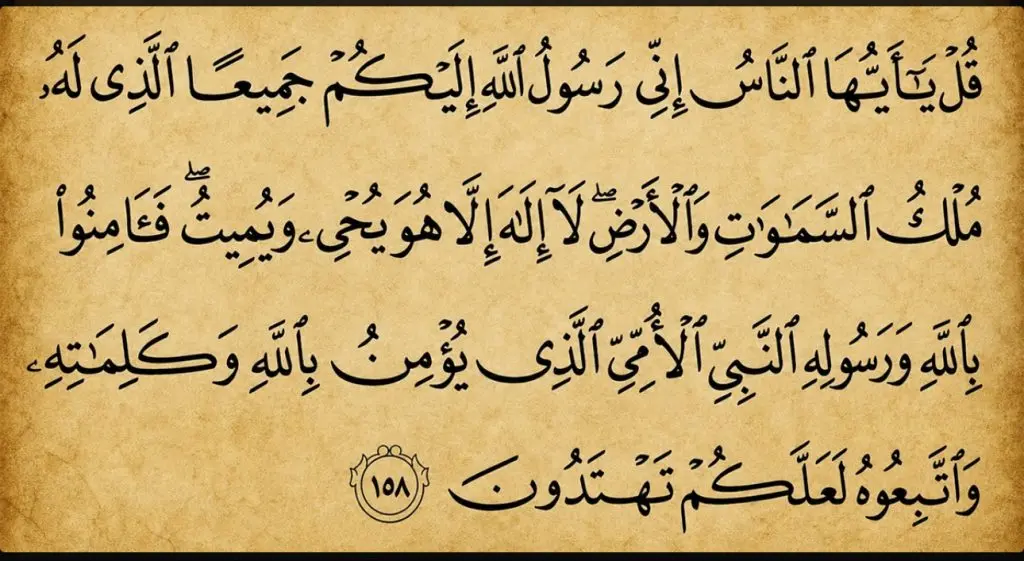
The Prophet Muhammad ﷺ لم is described as ummi in Surah Al-A‘raf, 7:158. This word is often translated as ‘unlettered’, but that translation is too limited and can be misleading. It gives the impression that the Prophet ﷺ lacked something, even though the original term does not carry that meaning. ‘Unlettered’ is often used because it sounds more refined than words like ‘illiterate’ or ‘ignorant’. However, it still points in the same direction, suggesting a lack that the original term does not imply. As a result, the translation does more than describe; it quietly influences how people think about the Prophet ﷺ himself. Over time, this meaning becomes taken for granted, even though it does not fully reflect the original term.
This piece challenges that understanding. The issue is not only the translation, but how the word is understood and used. When ummi is reduced to a narrow idea of literacy, its meaning becomes smaller and less accurate. A word that once described a particular position starts to suggest that something is missing. This shift may seem small, but it has bigger effects on how the Prophet ﷺ is viewed. So the problem is not just the translation, but the way we read and repeat it without questioning it.
Looking more closely, ummi has a richer meaning. It is often linked to umm (mother), which can point to a natural or original state, someone not shaped by formal systems of reading and writing. It is also used in contrast to ahl al-kitab (People of the Book), referring to those who were not part of earlier scriptural traditions. In this sense, ummi does not mean lacking knowledge, but rather being outside a certain kind of textual tradition.
Early scholars support this understanding. Figures such as Ibn Kathir and Al-Tabari explain ummi as someone who did not read or write from previous scriptures. This was not seen as a weakness. Instead, it showed that the Qur’an was not taken from earlier texts. The focus here is not on ability, but on the source of the message. In other words, the term highlights independence from earlier written traditions. It makes clear that the message did not come through copying or learning from previous books. Rather, it points directly to revelation as its source.
To understand this properly, we need to look at the society in which the Prophet ﷺ lived. In seventh-century Arabia, reading and writing were not the main ways people learned. It was an oral society. Memory was central. People were valued for how well they could speak, remember, and recite. Poetry was especially important. It carried history, identity, and knowledge.
In that kind of world, not writing things down did not mean a lack of intelligence. It simply meant knowledge worked differently. Authority came from strong memory and command of language, not from written texts. The Prophet ﷺ came from this society, yet the Qur’an he brought surpassed even the highest standards of language at the time. This makes the description ummi even more meaningful. It shows that the Qur’an cannot be explained as something learned through ordinary means.
The misunderstanding becomes even clearer when we consider what the Prophet ﷺ achieved. In just twenty-three years, he transformed Arabian society. What was once a divided and relatively marginal region became the centre of a growing civilisation.
If we compare this to other civilisations, such as the Roman Empire or the Sasanian Empire, we see a clear difference. These empires developed over many centuries. The transformation brought by the Prophet ﷺ happened within a single generation. It changed not only politics, but also social life, ethics, and ways of thinking.
To keep describing the Prophet ﷺ as ‘unlettered’ in the modern sense is to remain within a flawed way of thinking. It repeats a misunderstanding instead of correcting it. While the translation may capture one narrow aspect of the word, it is not the most accurate or contextually appropriate way to understand ummi. It carries meanings that the original term does not intend, and in doing so, it distorts more than it clarifies. A better understanding of ummi does not point to a lack, but to a particular position. It points to a form of knowledge that does not depend on writing, and to a message that does not come from earlier texts. It reminds us that knowledge can exist and be transmitted in ways that do not rely on books. It also shifts our attention from what the Prophet ﷺ did not do, to what he was entrusted with. In this way, the term ummi becomes meaningful not because of what is absent, but because of what it reveals about revelation and its source. Not every word can be translated without losing something important. At times, it is more honest to keep the Arabic term than to force it into an English word that does not fully fit.
Moegammad Tahier Kara is a Master’s student in the Sociology of Education (MEd) at University of Stellenbosch.

Presented and visualised by Anwar Cara